David Lynch on creativity and Ed’s Co-ed from The Bioscope

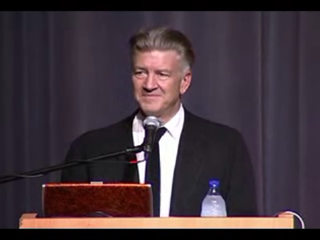
I just had a transcendentally enjoyable afternoon watching two videos: the first one I’ll discuss (actually the one I viewed second) was an (at times) insightful, and always highly engaging, free online recording of David Lynch‘s beatific guest lecture at the University of Oregon on November 8th, 2005, which I can thoroughly recommend to Film Studies For Free‘s (small but growing) ‘bliss-seeking’ readership. The link is HERE; there are various viewing options but I found the RealPlayer one to be the most straightforward on this occasion (and it also allows you to record the video, if you want). There’s also a podcast version HERE.

Following a lovely introduction by Associate Professor Kathleen Rowe Karlyn, the video shows Lynch amiably and very capably addressing a large gathering of fans and sceptics on the subject of “Consciousness, Creativity and the Brain,” with shorter speaking turns taken for part of the (nearly) two-hour long session by his fellow promoters of Transcendental Meditation, Drs. John Hagelin and Fred Travis.

Much of what Lynch has to say, of course, treats the topic of TM. Lynch is also widely-known now (as well as for his films) for his eponymous Foundation which promotes this practice in the declared interests of ‘world peace’. But there is plenty in the Lecture about his films and filmmaking practice more generally, too, thankfully, hence FSFF‘s recommendation. If you want to skip the ‘science’, Lynch answers great questions from the audience for the first fifty minutes and then returns for some more questions one hour and thirty-two minutes in.

A particular highlight for me was Lynch’s response to a question (about 28 minutes in) about Mulholland Dr. (USA, 2001): ‘What the hell is the box and the key?’. Lynch continues with an anecdote about the turning of the TV pilot version of his script into the full-length movie version. This, in turn, is immediately followed by a nice story I hadn’t heard before about Lynch meeting Federico Fellini just before the latter’s death in 1993.

It turns out, though, that Lynch has done this same gig numerous times, including at other universities. So, if you are a true believer, or you just really want an overload of “Consciousness, Creativity and the Brain,” or if, like me, (for a [meagre] living) you study what directors repeatedly say about their work, you could try out the Google Video of the talk as given on the day after the UOregon lecture at UC Berkeley, click HERE. Or, there’s a Google search page HERE giving a list of all the other, online and free video versions of this talk out there in cyberspace.

I came across the Lynch video at the University of Oregon Scholars’ Bank link because of a recommendation to check out another film stored in that online archive by Luke McKernan over at The Bioscope (see my earlier post about this fabulous blog HERE). The Bioscope is currently posting reports from the 27th Annual Pordenone Silent Film Festival/Giornate del Cinema Muto. In the report from Day 4, McKernan discussed, inter alia, a silent film made at the University of Oregon in 1929: Ed’s Co-ed. He warmly recommends it thus:

There is not a trace of amateurism about Ed’s Co-ed. The story is that of every college movie you ever saw – country boy Ed comes to college, is picked on by other students, he falls for the girl but is rejected by all after he admits to a crime to cover up for someone else who actually committed it, his talents are recognised (he plays the violin, he’s top in all his grades), he wins through at last. It’s so like every college film made that you could be fooled by its ordinariness, but this is a college film that actually came from a college, and it is a treasure trove of period attitudes, codes, fashions and language.

McKernan gives the great link to the streamed and downloadable versions of the film in the UOregon website. I thoroughly enjoyed this film (before Film Studies For Free‘s Lynch marathon) though would have loved to have seen it at Pordenone with the live accompaniment from Neil Brand (piano) and Günter Buchwald (violin).

Raúl Ruiz, and other directors, in webcast conversations via University of Aberdeen

The Directors Cut – Raúl Ruiz in conversation with Kriss Ravetto-Biagioli from 3sixty-tv/vimeo

The very enterprising and generous Department of Film and Visual Culture at the University of Aberdeen began its ‘Director’s Cut’ series of public interviews last year, and is now set to launch this year’s series, including conversations with Hans Petter Moland, Pawel Pawlikowski, and Jane Treays (also see HERE). The informative press release for this year’s series is HERE; please visit the series’ website for other details.

All of last year’s interviews have been made available online in wonderfully long webcasts. These are very substantial free resources, indeed. Alongside Kriss Ravetto-Biagioli‘s great conversation with Raúl Ruiz (HERE), there are interviews with Allan Shiach (HERE), John Akomfrah (HERE), and the fabulous Nicolas Roeg (HERE). There’s an interview with David Attenborough archived on a different page (but that one took a long time to load, so I haven’t fully checked it out).

The Director’s Cut series of interviews was the highly laudable initiative of Alan Marcus, Reader in Film and Visual Culture at Aberdeen, and a filmmaker himself. Film Studies For Free takes its deeply grateful blogger’s hat off to Dr Marcus, and to Film at Aberdeen, for enabling these conversations, as well as for ensuring their online availability to a much, much wider (indeed, global) audience.

Assorted recommendations

Thanks for some very nice email responses to Film Studies For Free‘s last posting. Today, FSFF brings you a round up of links to some great online resources.

  • First of all, a very good, film-related, online, Open Access journal that I didn’t have in my earlier list: Limina, a refereed academic journal of historical and cultural studies based in the Discipline of History at the University of Western Australia. For a good sample article, please try Tama Leaver‘s ‘Rationality, Representation and the Holocaust in Life is Beautiful’.
  • Next, please check out a great website run by the International Documentary Association (IDA) which has lots of items of academic Film-Studies interest: documentary.org. The best features (from FSFF‘s point of view) are lots of freely accessible, online video clips, and a very good selection of magazine articles drawn from the IDA’s print publication Documentary (link to latest issue on documentaries related to elections HERE, and to the magazine archive HERE).
  • Via ConvergenceCulture.org, a great link to audio and video recordings of the 2006 and 2007 Futures of Entertainment (1 & 2) conferences at MIT, including papers given by Henry Jenkins (see also HERE), Jason Mittell (see also HERE), and Danah Boyd ( see also HERE). I do hope that lots of other conference organisers will note just how great it is to be able to access international conference papers in this way, from anywhere in the world, albeit only with the right technology, of course. See the Convergence Cultures Consortium weblog for updates about Futures of Entertainment 3.
  • Somewhat tardily, I just discovered that you can subscribe to a truly excellent weblog by Moving Image Source (now added to Film Studies For Free‘s blogroll). FSFF has previously commented on the parent site’s great resources (including wonderful podcasts). The weblog has very high quality material, indeed: for example, see this great posting ‘This Way, Myth’ by Jonathan Rosenbaum (also see HERE).
  • Finally, for today, my recommendation of two of the most useful weblogs (for Film Studies academics, at any rate) that I’ve yet come across with a focus on film industry research.
    • The first is Bigger Picture Research – a ‘A no-nonsense look at film biz research from around the world’ – which is expertly run by Jim Barratt (also author of a soon to be published study of Peter Jackson’s Bad Taste (1987) by Wallflower Press). Bigger Picture Research has fantastic links, is frequently updated, and is beautifully (and most unfussily) set out. It does what it says on its tin, and more: in other words, it has an admirably global focus and reach. There is no better website that critically and concisely examines the commercial and industrial discourses of film. Please do subscribe (get the feed HERE)and support this blog!
    • The second is a link I’ve only just thought of adding to FSFF‘s lengthy blogroll, which is r a t h e r strange; as a researcher into contemporary cinema and the impact of new technologies on old film practices and discourses (like auteurism), it’s the blog I’ve been following the longest (since its inception in May 2005). The aforehinted-at website is CinemaTech, a blog that focuses precisely on ‘how new technologies are changing cinema – the way movies get made, discovered, marketed, distributed, shown, and seen’. It’s run by Scott Kirsner, a prolific film journalist and digital film commentator. It’s not as ‘links-oriented’ as Bigger Picture Research, but (like that blog) does give good opinion, as well as accurate news coverage, in very rapid response to film-industry developments. FSFF apologises profusely for waiting until now to link to CinemaTech. Please help to assuage its guilt by (co-)adopting this wonderful blog (get the feed HERE). Thank you.

Now, back to the global financial crisis… Have a good weekend, won’t you.

Film and Media Studies e-journals for free: online graduate-student work

Many of the writers on open-access research and scholarship have noted that there is a continuing reluctance among senior and established academics to publish in online scholarly journals. See, for instance, the excellent, detailed discussion of the academic unease around the ‘legitimacy’ of e-journals by Peta Mitchell (‘The Politics of Open-Access Publishing: M/C Journal, Public Intellectualism, and Academic Discourses of Legitimacy’ – link HERE). Mitchell notes that

[A]ll studies into online scholarship agree on this point—the authors of articles in open-access journals are, more often than not, comparatively young […]. [W]hile “younger authors were more likely to be positive about the outcomes of OA [Open Access] publishing,” “older respondents were more likely to worry about the quality, for example, that papers will become less concise” ([Nicholas, David, Paul Huntington, and Ian Rowlands. “Open Access Journal Publishing: The Views of Some of the World’s Senior Authors.” Journal of Documentation 61.4 (2005): 497–519.] 512). […]

Opinion is divided as to whether this situation has changed in recent years following the exponential growth of open-access publishing. Certainly, the abovementioned 2005 study indicates that most respondants did not see open-access publishing as “radical” or as having no career advantage (Nicholas, et al 507). However, this is tempered by the fact that authors from countries that had a “poor commitment to OA publishing”—notably Australia, North America, and Western Europe—”associated OA with ephemeral publishing, poor archiving and no career advantage” (517). Moreover, as the authors of the study note, “perhaps the biggest finding to emerge from the study is the general ignorance of OA publishing on the part of relatively senior scholarly authors” (515). […]

The ongoing nature of the open-access debate reveals the core of the problematic facing open-access journals: that while it is now deemed safe to use online scholarship, it is still not entirely safe to produce it.

Despite these residual qualitative doubts, Mitchell notes that all ‘stakeholders’ in academic publishing have acknowledged that ‘open-access journals are cheap, fast, and quantitatively sound’. It is precisely these qualities that can make them an ideal vehicle for those who need quickly to get their work out in public; indeed, e-publishing can provide an ideal ‘shop window’, akin to the giving of a good conference paper, for early career academics.

There are already quite a good number of open-access e-journal ‘outlets’ run primarily for and by established film and media studies academics. As well as linking to a large number of online film magazines in its listing of ‘Online and Open Access Film-Studies Related Journals and Magazines, Film Studies For Free currently connects to the following active, fully peer-reviewed, and free-to-access e-journals ‘:

16:9 (Eng-lang articles in Danish Film Studies Journal); Americana (Hollywood) : the Journal of American Popular Culture; Consciousness, Literature and the Arts; CTheory.net; Culture Machine; Fibreculture Journal; Film-Philosophy; Framework [online sections]; Genders; Image [&] Narrative; Intensities: The Journal of Cult Media; International Journal of Žižek Studies; Irish Journal of Gothic and Horror Studies; Journal of Moving Image Studies (archive online); Journal of Religion and Film; Jump Cut; M/C Journal: A journal of Media and Culture; Media History Monographs; Mediascape; Middle East Journal of Culture and Communication (first issue 1 online); P.O.V (A Danish Journal of Film Studies – peer-reviewed since December 2007); Particip@tions; PsyArt; Scope: an on-line journal of film studies; Screening the Past; Senses of Cinema; Trama y Fondo (in Spanish); Transformative Works and Cultures; ; Vectors; Wide Screen (new journal calling for papers); World Picture Journal.

I hope to return to discuss issues of (and matters concerning) the above-listed journals on future occasions, but I wanted to focus, in what remains of today’s blog entry, on profiling three of the best examples of e-journals that are produced primarily by Film and Media Studies graduate students. I think they are producing some of the most interesting models for online, Open-Access work in our discipline(s) (and all are linked-to by Film Studies For Free).

FlowTV
According to its website:

  • Flow is an online journal of television and media studies launched in October 2004. Flow’s mission is to provide a space where researchers, teachers, students, and the public can read about and discuss the changing landscape of contemporary media at the speed that media moves. Flow is a project of the Department of Radio-TV-Film at the University of Texas at Austin. Flow is coordinated and edited by graduate students in the Department of Radio-Television-Film and is published bi-weekly.’

The site adds:

  • ‘Accompanying the challenge of publishing material at that demanding pace has been the related project of building and operating our own delivery system. With over 500 columns in our archive, representing the work of over 200 authors, ensuring the stability of this venture is one of our primary concerns.’

The main advantage of Flow is clearly its prodigious responsiveness. But there’s another feature that I really like; while the journal seems not to be conventionally (or ‘fully’) peer-reviewed, its excellent comments feature means that the exchanges provoked by the journal are open and critical – work published there can be publically and thus very usefully challenged. For example, see Flow Journal, Vol. 8, Issue 7: this issue featured columns from Jane Feuer, Aaron Delwiche, Leigh Goldstein,and Alexander Cho. Flow staff writer Leigh Goldstein’s great piece“Soft Selling Intergenerational Intimacy on the First Season of Mad Men” examined ‘the unmasking [in that series] of society’s discomfort with representations ofchildhood sexuality’. It sparked nine very well thought out comments which were reproduced on the same webpage, including a very interesting comment from the renowned film and TV studies academic and theorist Karen Lury, who has also contributed her own work to Flow (also see HERE), alongside another fascinating point posted by the great Julia Lesage. You can’t get better, or more instant and transparent, review by your ‘peers’ (or, indeed, by your ‘betters’) than that! Flow is well worth a (free) subscription, in Film Studies For Free‘s humble opinion.

Synoptique

After a four year hiatus (of the kind that is sadly still all-too-common in the volatile world of academic e-publishing), SYNOPTIQUE: The Journal of Film and Film Studies, a film journal written and published by graduate Film Studies students at Concordia University in Montréal, is back.

Synoptique gives a dazzling account of its rationale, which should be read at length; but here’s a little taster:

  • [I]t is only with the frame of a film community that we can think about film. And its education. We wanted to create an online resource of student work at Concordia. For students at Concordia. To give expression to the intellectual character of M.A. Film Studies at this University by publishing what was rapidly becoming a lost history of ideas. Students work here for two years, take classes, write theses, go on their way, leave faint traces, might never take a stand or apportion an opinion. We wanted to discover what tradition we had inherited, what debates we were continuing, which debates we weren’t inventing.

The editors hope that Synoptique will be a ‘quarterly, academically-oriented, online journal about film culture.’ The latest articles (issue 11) have been ‘exposed to a peer-editing system.’

While the articles do have a slight ‘graduate flavour’ in places, they are very well-written and edited, and are as compelling and interesting as you would hope any article in a film journal would be – some very nice essays, in particular, on childhood in avant-garde films, Lynch’s Inland Empire and Potter’s Orlando, among others (in English and French). Synoptique also has options for leaving public comments, although its traffic is not currently as lively as that of Flow. Film Studies For Free wishes it all the best: it deserves a long and garrulous life.

Cinephile
Another journal that has successfully relaunched recently is Cinephile (formerly UBCinephile). Cinephile is a free, (now) peer-reviewed journal of film studies edited by graduate students in the Film Studies program at the University of British Columbia. The journal

aims to provide a forum to discuss aspects of film theory, history, and criticism, and is intended to provide a platform to share research papers, book reviews, and reports that engage with debates appropriate to film, media, and cultural studies. As a peer-reviewed journal, Cinephile endeavors to promote the Film Studies portion of the program as an inclusive but discriminating environment which is dedicated to publishing work of the highest scholarly quality and appeal

The previous three volumes of (UB)Cinephile can still be accessed online and they are well worth checking out (see HERE or HERE). There are thoroughly stimulating, and highly original articles by (then) students honing their skills (and sharpening their talons), and UBC faculty —

e.g. Lindsay Steenberg – “Framing War: Commemoration, War & the Art Cinema”; Christine Evans – “‘I am not a fascist, since I do not like shit. I am not a sadist, since I do not like kitsch’: Sadism, Serial Killing, and Kitsch”; Brock Poulin – “Reading Against the Gore: Subversive Impulses in the Canadian Horror Film” ; Brenda Wilson – “Blurring the Boundaries: Auteurism & Kathryn Bigelow”; Jennie Carlsten – “Violence in the City of God: The Fantasy of the Omniscient Spectator”; Renee Penney – “Bloody Sunday: Classically Unified Trauma?”; Jennie Carlsten – “‘Somehow the Hate has got Mislaid’: Adaptation and The End of the Affair“; Christine Evans – “I’m in Love! I’m a Believer!: Structures of Belief in Jonathan Glazer’s Birth“; R. Colin Tait – “‘Jesus is Never Mad at Us if We Live with Him in Our Hearts’: The Dialectical View of America in David O. Russell’s I (Heart) Huckabees“; David Hauka – “Christ, that Hurts!”: Rewriting the Jesus Narrative – Violence and the Language of Action Cinema in Mel Gibson’s The Passion of the Christ“; Katherine Pettit – “Metamorphic Death: Post-Mortem and Spirit Photography in Narrative Cinema”; Jennie Carlsten – “Containing Their Rage”; Andrew deWaard – “The Global Social Problem Film” ; Tara Kolton – “Representations of Western Tourism in Cinema” Brenda Cromb – “War Films Without War”; Christine Evans – “Medea’s Family Reunion”; R. Colin Tait – “(Zombie) Revolution at the Gates”

— as well as by possibly even more redoubtable figures, such as Slavoj Žižek ( “The Family Myth in Hollywood”; see also HERE).

In the (re)launch issue of Cinephile (on a new website, equipped with an RSS feed to keep you updated, as well as with a comments facility), there are some wonderful articles by familiar names (both from previous issues of (UB)Cinephile, as well as those of such well-established luminaries as Barry Keith Grant). But there are also some very worthy pieces by some new(er) names (such as the timely and important ‘Cinema from Attractions: Story and Synergy in Disney’s Theme Park Movies’ by my fellow blogger Andrew Nelson, a PhD student in Film at the University of Exeter). In any case, the result for Cinephile continues to be a stream of highly invigorating articles, written in a throroughly engaging, and occasionally even entertaining, way. Inspiring, indeed.

Also, look out for Tischfilmreview, to be launched later this year by the world-renowned Tisch School of Film and Television, NYU. Like Flow, Synoptique and Cinephile, its anchor in an educational institution of excellent repute would seem to be a great way of guaranteeing the ongoing archiving of the work it publishes, as well as of raising the profile of those whose work it will showcase online. We may go on to see the birth of literal-but-virtual ‘Schools of Thought’ in film and media studies (hmm: always remember Birmingham…). Maybe these newer, online ones are being forged in a more ‘open and accessible’ environment than was previously possible for participants in our disciplines, if only technologically.

Do, then, consider yourselves urged to visit the Cinephile, Flow, and Synoptique websites. And also, as (if not more) importantly, please think seriously about submitting your research ‘outputs’ to them for consideration for publication, as well as to the other e-journals mentioned earlier in my discussion, and permanently linked to by Film Studies For Free. It may seem a volatile ‘marketplace’ out there in cyberspace, as elsewhere. But do you really have anything to lose except your reluctance?

[If you know of any free film and media studies e-journals to which Film Studies For Free is not yet linking, please let me know and I’ll check them out. Thanks]
Type casting … and Bette Davis

Fun little item on the BBC website today about how typefaces are chosen for movie posters. Sebastian Lester, a typeface designer, runs through the typographic design rationales for a whole host of movie campaigns, including the soon to be released Quantum of Solace (Marc Forster, UK/USA, 2008).
Here’s some of what Lester has to say about the poster for that movie:
The [Neutraface] typeface used in the new James Bond poster has its roots in the early 20th Century and the architectural lettering styles of that period […]. Geometric fonts like this have a sense of efficiency and modernity about them which is universally appealing.

Bette Davis fans are currently celebrating the centenary year of her birth on April 5, 1908, but today is the anniversary of that great actor’s death in 1989. I thought I’d mark the occasion by providing a short webliography of related scholarly and other online resources of note.
Film Studies For Free will be back imminently with a post on online, open-access, graduate film and media studies journals.

Paul Newman, 1925-2008

One of the most intelligent Hollywood actors (and directors) ever, Paul Newman, died last Friday at the age of 83. Newman studied acting at Yale University and, under Lee Strasberg, at the Actors’ Studio in New York City. His first film acting role was in The Silver Chalice (1954), and his career in the movies went on to span six decades.

There’s a report and a good obituary on the BBC website (links HERE and HERE). And below you can find the three sections of a good video overview of Newman’s career, together with that of his partner, Joanne Woodward, who survives him.

YouTube videos posted by Cammie37, respectively HERE, HERE, and HERE.

It’s a Wonderful Point…

It’s a Wonderful Life bank run scene, posted on YouTube by NemoPublius (March 30, 2008)

A little bit of … not very scholarly fun, today.

Chris Cagle over on Category D posted very wittily last week about the wonderful things that go on in the media While Rome Burns

Well, exactly a week has gone by since his post, and Rome is still burning, but I just wanted to share an essential link with you to an item from the BBC Radio 4 Today programme, as reported by the BBC website today, which was based on the quintessential ‘film-studies film’, It’s a Wonderful Life (Frank Capra, USA, 1946). The BBC page link is HERE; and the related Today programme audio file link HERE).

A little taster:

Russell Taylor, one of the writers of Alex, the cartoon of city life which runs in the Daily Telegraph’s business section, has written his own version of James Stewart’s speech from It’s A Wonderful Life [see video embed and audio file above]. It captures just how Alex Masterley – the caddish hero of the comic strip – would describe the events of the past week.

“So, you want to withdraw the money you deposited with us? Yes, well, I’m afraid we can’t give you back your money because we don’t have it. You see, what happened is that we lent the money you gave us to Joe and the Kennedys and Mrs Maklin to buy houses with, and then we lent them some more money to buy a second property on a buy-to-let basis and a third rental property too and then we lent them some more money against the value of all the various properties that we’d lent them the money to buy, so they could go on a nice holiday…”

And on it goes. Funny stuff. And timely, too. But, as they sometimes say in and around Rome, “Fa caldo…”

More on artists’ film and video: an e-book, and ‘vodcast’ links

From Ecology, directed by Sarah Turner, 2007. Photo: Matthew Walter/Sarah Turner

A few more links have been added to Film Studies For Free‘s list of film-scholarly podcasts and videocasts, most notably one to a page on the LUXONLINE site, a brilliant web resource for exploring British based artists’ film and video in-depth (offering critical writing, stills, streaming video clips, and other contextual resources).

The link I’ve just added is to LUXONLINE‘s offering of ‘vodcasts’ of interviews with leading British film artists and curators (link HERE, please note, though, that you need to be registered first with iTunes in order to access almost all of the vodcasts). There are video interviews with Andrew Kötting, Angela Kingston (independent curator), Tina Keane, Ruth Novaczek, Chris Welsby, Alia Syed, Stephen Dwoskin, and Harold Offeh. The latest vodcast is with Sarah Pucill (there’s currently no need for an iTunes account for this one: there’s a direct link HERE)

The LUXONLINE site also has a lot of original artists’ films, or clips from artists’ films, available for viewing in streaming video, so it is well worth taking the time to explore the site properly. You can start your searches for resources by particular artists HERE and for particular streamed films/clips HERE.

There’s another organisation which has even more user-friendly listings to assist with tracking down British-based artists’ film available for viewing more generally on the web (links HERE and HERE). The British Artists’ Film and Video Study Collection is a research project led by David Curtis and Steven Ball and based at Central St Martins College of Art and Design, London. It focuses in particular on the history of artists’ film and video in Britain.

Like LUXONLINE, the British Artists’ Film and Video Study Collection also provides a good collection of freely accessible research papers on artists’ film or by film artists (link HERE), including ones by Malcolm Le Grice and Michael Mazière. There’s also a paper by my friend and former colleague in Film Studies at the University of Kent, Sarah Turner, which sets out some of the conceptual background to her 2007 film Ecology (read a BBC interview HERE), which premiered at last year’s Cambridge Film Festival.

Finally, there’s also a link now in Film Studies For Free‘s ‘Film Open Access e-books’ listing to Gene Youngblood‘s hugely influential and prescient Expanded Cinema, a 444 page book, originally published in 1970 (downloadable in a single .pdf via Ubu.com; and also accessible HERE in separate sections via http://www.vasulka.org/). Expanded Cinema, as the very useful Wikipedia article on it argues, was

the first book to consider video as an art form, [and] was influential in establishing the field of media arts. In the book [Youngblood] argues that a new, expanded cinema is required for a new consciousness. He describes various types of filmmaking utilising new technology, including film special effects, computer art, video art, multi-media environments and holography.

Some Bordwellian inspiration (in blogpost and podcast)

The latest blog post by David Bordwell (‘They’re looking for us‘, 19 September 2008) treats the important issue of the reaction shot, a film technique which provides ‘one of the most enjoyable and arousing dimensions of cinematic storytelling’.

Bordwell’s post is, as usual, a remarkable, and beautifully illustrated, piece of digital scholarship which takes us, very entertainingly, from a contemporary example of a reaction shot (drawn from the 2007 film Music and Lyrics, directed by Marc Lawrence), and working thus in the context of what Bordwell considers intensified continuity editing; through Steven Spielberg‘s Jaws (1975), John Woo’s A Better Tomorrow (1986), Carl Dreyer’s La Passion de Jeanne d’Arc (1928), and Carol Reed‘s The Third Man, ending up with Road Warrior (1981, aka Mad Max II, directed by George Miller).

Bordwell’s impressive tour of this technique explores the many ways in which the reaction shot instructs us ‘in how to respond to the fictional world as a whole’, as well as cognitive, or neuroscientific, theories of how ‘Reaction shots may gain their strength from not merely our ability to understand facial expressions but the power of facial expressions to trigger in us an echo of the emotion displayed.’

Bordwell concludes his highly informative and enlightening post with characteristic modesty: ‘There’s much more to say about the reaction shot’. He’s right, of course: we might ‘want as well to talk about films that withhold information about characters’ reactions—by using enigmatic or ambiguous reaction shots, or by eliminating reaction shots altogether’. ‘ But it is really difficult to imagine saying anything more, or saying anything in a more illuminating way, in under 2,750 words. With their blog Observations on film art and Film Art, Bordwell, and Kristin Thompson, his partner and frequent co-writer, have very much perfected the art of concise and scholarly digital communication.

We must be very thankful, thus, that both of them came to be inspired by the possibilities for the creation and dissemination of new film scholarship which are offered by the internet, in general, and by weblogging, in particular. There’s a great podcast in which Bordwell talks about this very topic (recorded in January 2007), which is very much worth checking out. It’s accessible HERE at Zoom in Online (be warned that you have to endure a short advert, and not-the-best audio quality, though).

[Note added on September 8, 2008: Check out a fascinating, subsequent post on reaction shots – ‘Non-Reaction Shots’ on the great blog IScreen Studies, by Ben Goldsmith, who reacts very productively indeed to Bordwell’s thoughts]

More great Film Studies podcasts: Pinewood Dialogues

I just came across another great, free source of podcasts of film scholarly note, via the wonderful Museum of the Moving Image‘s  Moving Image Source website, where I was checking out a girish recommendation for the publication of September articles.

The podcasts are accessible via a Moving Image Source page called Pinewood Dialogues (‘Selected Conversations with Innovative and Influential Creative Figures in Film, TV, and Digital Media’). There are some 73 podcasts currently posted, of interviews with, and dialogues between, filmmakers and other creative folk, including the likes of Werner Herzog and Jonathan Demme, Stan Brakhage, Martin Scorsese, Thelma Schoonmaker, Michael Powell, Patricia Rozema, George A. Romero, Fernando Meirelles and Rachel Weisz,  and François Ozon, among many others.